First of all, what is logic?
To solve a problem with logic, it’s the ability to generate solutions to a problem. In other words, it’s a manifestation of our lives at every moment. Because even in our daily lives, it’s our humanity that allows us to solve even the smallest problems. So, how do humans solve a problem? A human being tries to derive new conclusions by storing the information they have. In other words, logic is the art of distributing their information to reach a power they don’t possess.
Now, we can examine this situation from different perspectives and with examples.
I’ll ask you a question: is there a pin where it can be stored? You can find out. Let’s assume there are two answers: yes or no. While showing a pin where the information is filed is sufficient for you to present the transmission of this information, to provide participation in this section, you must first thoroughly examine every part of the data environment and investigate its location. If you still can’t find it, you can claim this amount. The situation here isn’t actually a yes or no; the point we’re trying to draw attention to is that there’s a needle you don’t know about, and to prove that needle isn’t included in your knowledge, you’d first have to scour the entire room to gather information. However, if you do know that needle exists, proving it is much easier than in the other scenario. In fact, we used pure logic here. A few correct answer applications were implemented by storing data we have and data we don’t have. Establishing the logic seen in this example requires correlating old information. To achieve this increase, we need to have reliable information about the initial propagation.
Now, let’s consider this issue from a computer’s perspective.
Computers are housed like human-designed brains. Logical execution in a computer essentially involves predefined rules, reductions, and the duration of the effect. If there’s a deficiency in this framework, it won’t function properly. This is because if the correct values for this brain parameter, that is, the correct information, are not provided, even if all the information and effect are correct, a missing parameter will cause the computer to stumble during the program’s execution if that parameter is missing. In other words, scenarios unknown to the computer cannot be constructed or executed logically because they can be encountered with the rules and consequences given to the brain. If any inaccuracies in this information prevents the computer from correctly configuring the screen, and the program still reveals the cause of the problems. Let’s give a simple example. Imagine a form containing your name, surname, and ID number. If you enter your name and surname correctly but only one digit of your ID number incorrectly, the computer won’t match you with anyone because there’s a fixed underlying data set. It will take three parameters generated by the computer and find the person who matches these three parameters. If you enter one of the parameters missing, your computer won’t make any inferences, assuming they are similar to this person. The point here is that for the given person to yield accurate results, the given person must be correct. If missing or incorrect parameters are given, the computer will not produce any results.
Let’s get to the main point: just as we can open and read a computer, we can now evaluate the openness of AI in terms of its constructions.
In this blog, I will actually focus on a specific point regarding AI under my leadership. What distinguishes AI from computers in graphical editing is that when AI demonstrates its incompleteness, it fills in this copy through guesswork. This is precisely where all the trouble begins. The AI actually generates a solution to the problem by guesswork. However, because this solution you receive is purely AI guesswork, you’re actually getting the temporary speeds you believe are correct. You’ll continue with some scenarios about writing software and code.
Now, we’ll imagine a scenario. I’ve provided a clear example. In this example, my data file is in CSV format, but I didn’t specify it in the prompt. In this case, I provided a missing parameter regarding the data format. In this case, the AI made a guess and evaluated the data format as .json, and the code was written to retrieve data from a JSON file.
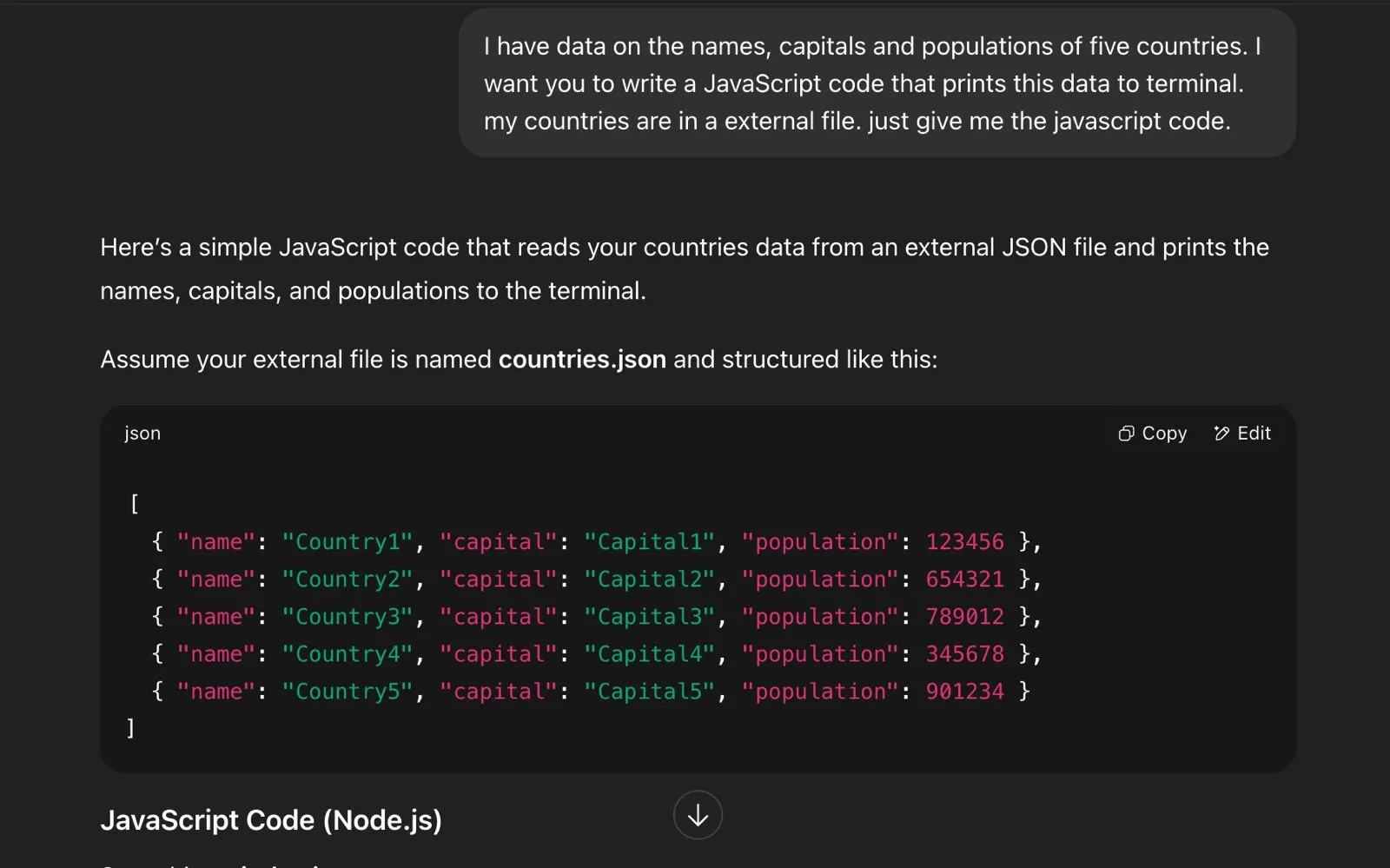
What happened here is that the AI filled in the missing parameter I provided by making its own guess. Ultimately, the AI produced a correct result, but it was technically incorrect because it wasn’t suitable for my project or the structure I used. Consider the potential problems that could arise in larger examples using this simple example. If you’re working on a much larger project and hand all the control to the AI, and you completely do what the AI tells you to do without taking control, the AI will fill in the missing parameters at many points with its guesses to create workarounds. Later in the project, you’ll discover major, irreversible structural flaws at the core of the project.
So, what’s the point here?
Yes, AI may be very good at writing code, but without a person properly managing it in the logical construction and engineering aspects, the code it generates is essentially meaningless. Because if the AI isn’t given all the parameters, it’s not yet capable of establishing all the logical relationships. It can only derive a conclusion by establishing a relationship on its own. Yes, it can, but without the necessary parameters, this result becomes an answer filled in by guessing. This doesn’t make AI an engineer at this point.
In fact, for these reasons, the human brain and AI’s brain become separate, and a scenario emerges where AI still needs us: “Logical associating.” If you can have AI establish this associating and make AI your employee, then you’ll be using current technology to your advantage and achieving success.
When you aim to be an engineer, that is, the person who establishes logical relationships, AI acts as a subordinate, allowing you to complete tasks much faster and more accurately. This is because, as an engineer, you know what you need to do in which part of the project, and you’ll be able to provide specific requests and parameters to the AI when writing prompts.
However, if you don’t do it this way and try to have the AI do everything, you’ll end up with a pile of code garbage. If you’re not an engineer skilled in establishing the project structure and logical associating, it will be very difficult to tell the AI exactly what you want, and you’ll naturally leave missing parameters.
In conclusion, yes, AI is a good programmer, and yes, computers can execute the complete commands given to them much faster and more professionally than humans. However, because computers can generate results based on pre-designed algorithmic structures and logical relationships, everything must be given to the computer accurately and completely to achieve results. This is a slightly different situation in AI. The parameters we provide to AI must be complete, because if we leave them out, the AI will fill in those missing parameters with its own guesses, leading us to the wrong conclusion in the long run. In other words, unless an engineer oversees the AI and provides it with complete and accurate instructions, the AI’s answers are unreliable.
This brings us to the question that’s being discussed worldwide: “Will AI take over the jobs of software developers?” Yes, AI can and will always write better code than we do, but at this stage, AI cannot fully construct logical relationships and constructs without a human being in charge. The answer to our question is this: If you are an “engineer” who knows what they’re doing and has developed the skills to construct and reason, then no, you won’t be left without a job. However, if you are someone who is trying to get by in the software industry by just writing code with AI without relying on any fiction or logic, I fear that there is a high probability that your job will be taken away from you in the coming years, as an engineer who uses AI correctly may be able to do much better and higher quality work than you.