What is JSON?
JSON (JavaScript Object Notation) is a structured data format used for storing and transferring data. It’s widely used in APIs, configuration files, and web applications.
JSON Example
[
  {
    "id": 1,
    "name": "John",
    "age": 25
  },
  {
    "id": 2,
    "name": "Jane",
    "age": 30
  }
]
Key Characteristics
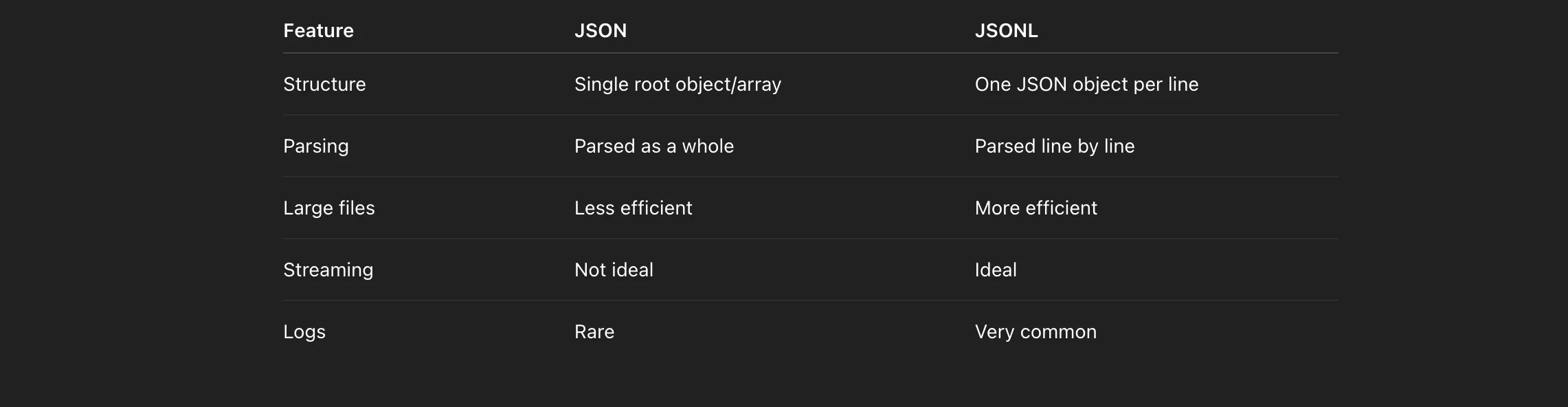
- Data lives inside a single root structure (
[]or{}). - The entire file is parsed at once.
- Ideal for small to medium-sized datasets.
- Commonly used in API responses.
What is JSONL?
JSONL (JSON Lines), also known as NDJSON, stores one valid JSON object per line.
Instead of wrapping everything inside an array, each line is independent.
JSONL Example
{"id": 1, "name": "John", "age": 25}
{"id": 2, "name": "Jane", "age": 30}
Key Characteristics
- Each line is a standalone JSON object.
- Easy to process line by line.
- Great for large datasets.
- Commonly used for logs and machine learning datasets.
- Suitable for streaming data.
When Should You Use Each?
Use JSON when:
- Building APIs
- Writing configuration files
- Working with small/medium datasets
Use JSONL when:
- Handling large datasets
- Processing streaming data
- Storing logs
- Preparing ML training data
Quick Summary
- JSON = One structured document
- JSONL = Many small JSON documents, one per line
- Small data → JSON
- Large or streaming data → JSONL